

Money for nothing?
Why borrowing to join the EU's SAFE program is a silly idea.

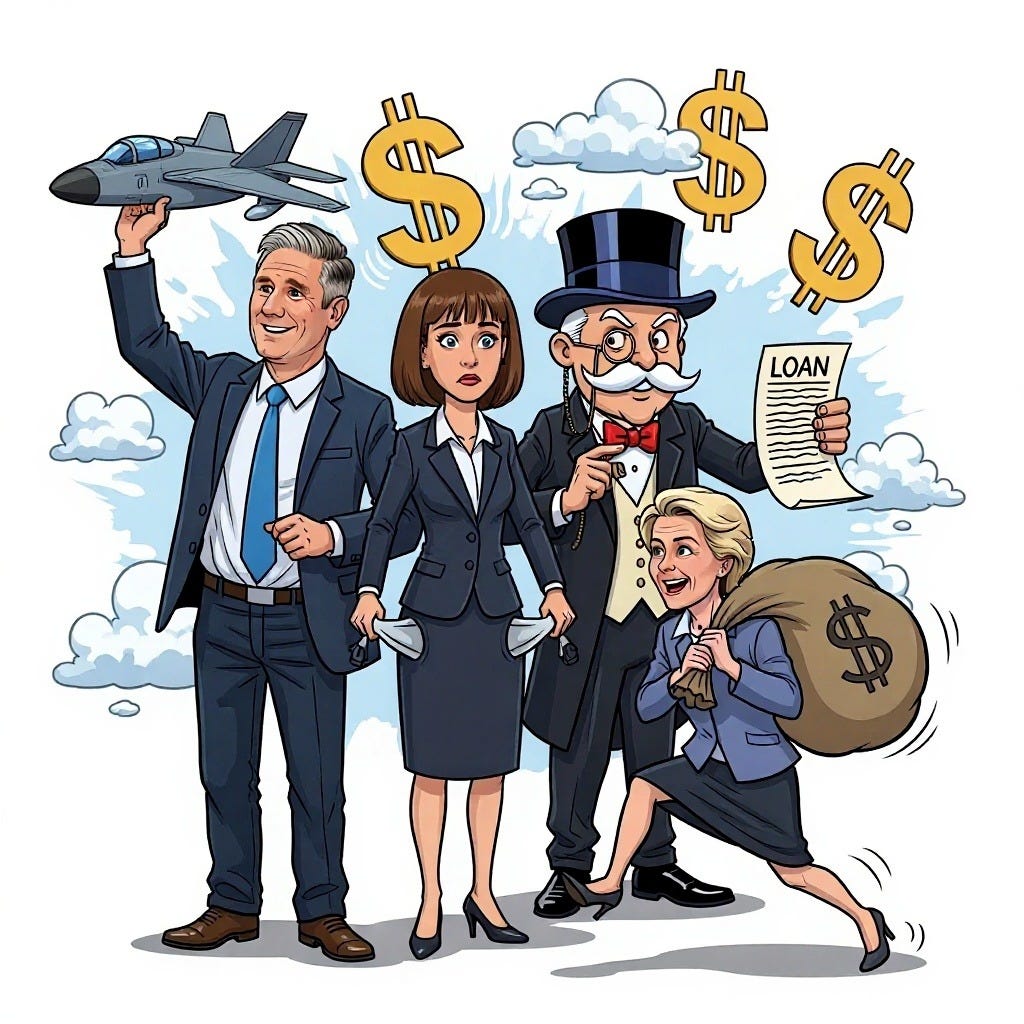
Despite what you may have heard about the UK’s financial Crisis and the ever-expanding black hole, the UK Government is currently contemplating paying the EU between €4 billion and €6.5 billion to be able to participate in the EU’s Security Action For Europe (SAFE) program, plus a trifling €150 million for administration fees. The SAFE program is a €150 billion EU loan scheme designed to reduce the EU’s reliance on the US for defence supplies and boost EU arms production.
Participation in the program would enable UK defence companies to bid for up to 50% of SAFE-funded contracts, provided they meet the required content requirements. SAFE demands that 65% of any defence equipment purchased must be manufactured within the EU, EEA, EFTA or Ukraine. The 65% covers manufacturing, component sourcing, assembly and integration, as well as software and systems engineering. If UK products do not meet the 65% rules, they would be ineligible for SAFE funding, regardless of whether the UK had paid to join. There is also no refund if UK defence firms fail to win any bids for defence equipment. So joining SAFE could well be money spent for nothing in return.
In addition to the 65% content requirement, the EU or an EU-based partner firm must also retain control over the design and critical components. For example, if the UK pays to join SAFE and BAE Systems develops a radar system in the UK, but wants to retain design control, this would not meet the SAFE conditions, and the Radar would not be eligible for SAFE-funded projects. However, if BAE built the radar system in Poland and allowed its EU partner company to hold the design authority, then the radar could potentially be purchased using SAFE funding.
The UK would also not be eligible for EU-issued loans to purchase defence equipment; however, it would be able to participate in joint procurements with two other EU member states. The three countries would have to buy together to qualify for the SAFE program.
Effectively, UK taxpayers would be borrowing money to join the EU’s SAFE program, where benefits depend on competitive success and with no guarantee that UK firms would win contracts worth more than the value of the UK taxpayers’ contribution.
But who really benefits from this program?
Unsurprisingly, UK defence firms are eager for the government to pay up so that they can begin bidding for contracts. BAE Systems, Babcock, and MBDA are apparently already preparing bids.
Like all EU schemes, the EU gathers funds from general taxpayers and redistributes the money to selected companies, groups, or, in the case of CAP payments, landowners. The EU also, as usual, reserves harsh treatment for the UK, despite the UK-EU Security and Defence Partnership signed in May this year, which appears to have no value whatsoever. In contrast, both Norway, Iceland and Ukraine have been allowed to join SAFE for free and their territories are included in the mandatory 65% manufacturing footprint, unlike the UK.
Show me the money
Most people in the UK now understand that the UK doesn’t have any spare money. We have been living beyond our means for many years. Therefore, any increase in government spending, whether for EU defence programs or UK welfare payments, must be covered by increased borrowing, and UK government debt is currently more expensive than that of any other G7 country.
So, why would the UK agree to borrow up to £5.7 billion at 4.4% (10-year Gilt) so that a group of UK-based defence companies could potentially secure a contract to manufacture 65% of their equipment in the EU, EEA, EFTA, or Ukraine? With no guarantee that UK defence companies would win any SAFE contracts, let alone SAFE contracts worth more than the UK Taxpayers’ ridiculously generous donation to the EU.
Who are these UK defence companies, and exactly how do they qualify as British?
The UK’s major defence companies are based in the UK, but several are actually subsidiaries of EU companies. The leading UK defence companies include:
BAE Systems plc, an LSE publicly listed company that is almost 73% owned by non-UK interests, including 41.6% by US-based shareholders, including Capital Group, BlackRock and Vanguard, among many others.
Babcock, also publicly listed on the LSE, and 65% owned by non-UK shareholders and is also 40.6% owned by various US shareholders.
Thales UK, which is a subsidiary of Thales SA (France) and 26.6% owned by the French Government and 26.6% owned by Dassault Systèmes, a French aerospace and defence company. The French Government and Dassault effectively control this company.
Leonardo UK, a subsidiary of Leonardo SpA (Italy), which is 30% owned by the Italian Government, as well as major US and French shareholders.
MBDA UK, a subsidiary of MBDA SAS (France), which is owned by BAE Systems (UK) (37.5%), Airbus (EU) (37.5%) and Leonardo (Italy) (25%).
QinetiQ, a LSE publicly listed company that is about 65% owned by shareholders in the US, Norway, Germany and France.
However, despite their not very British ownership, UK taxpayers should expect the UK to benefit from an increase in employment in the defence sector. Unfortunately, even if UK taxpayers pay up so that these not very British companies can bid for SAFE contracts, at best, only 35% of the contract production could happen in the UK. Worse still, it is likely that UK manufacturers would need to import materials as the UK’s high energy costs have caused many UK materials manufacturers to close or relocate offshore. This would further reduce the UK domestic content of any bid.
But is donating money to the EU really necessary for these companies to sell their products in the EU?
The most ridiculous part about the UK government borrowing money that UK taxpayers will have to repay in 5, 10 or 30 years’ time, then the government giving that borrowed money to the EU in the dubious hope that the EU may loan some of the funds to EU Member States so that they could possibly buy defence equipment from UK based companies, is that these UK companies make exceptional defence equipment that they sell internationally without the UK government paying to join a club that limits the amount of UK made content in their products. Why would anyone, other than the EU, think this carousel-like trade is a good idea?
BAE Systems is one of the world’s top five defence contractors and sells equipment to Saudi Arabia, Qatar, Australia, the US and Oman. MBDA UK is already part of the pan-European missile consortium and also sells equipment to Saudi Arabia, India, and Qatar. Leonardo UK has sold defence equipment to the US, Qatar and Brazil. QinetiQ has sold equipment to the US, Australia, Canada and Nato Allies. Babcock has sold equipment to Australia, Canada, New Zealand and Indonesia. Thales UK has sold defence equipment to Australia, the UAE and Singapore.
If these private and foreign-government owned companies can meet unsubsidised international demand for defence equipment, why are UK taxpayers being asked to subsidise their possible, but not certain, equipment sales to the EU?
Plus ça change, plus c’est la même chose
The Government’s EU Reset is an exercise in doing the same thing again and expecting a different result. The EU is desperate for money. They are not interested in playing fairly. Nor are they interested in buying the best defence equipment available. The EU is only interested in preserving itself, which it hopes to do with UK taxpayer-subsidised EU defence industry employment. It is time that UK taxpayers and Rachel Reeves learnt how to ‘just say Non!’ to the EU Reset.
I am not opposed to the UK borrowing to invest in UK defence equipment for the UK armed forces. In fact, I think it is a very good idea. However, if UK taxpayers are going to borrow to buy more defence equipment, they should either choose the best available equipment or, if Rachel Reeves wants to boost the UK economy, then the money should be spent with UK-based companies that produce as much of the equipment as possible in the UK. This would also qualify as investment spending and get around Reeves’ Budget rules that exclude borrowing for day-to-day spending.
However, for the UK to borrow money in order to support EU manufacturers and EU defence spending is a stupid idea. What part of the word ‘broke’ does the Government not understand?