

Not settled science
What the BBC doesn’t understand about UK EU trade


Last week, the BBC declared that it had not breached its impartiality rules, claiming there were no significant counter-voices arguing for positive or even neutral effects of Brexit on the UK economy. The BBC likened Brexit to settled science, such as ‘Climate Change’. Considering that the IPCC has recently abandoned its extreme Representative Concentration Pathways (RCP) 8.5 and its intermediate RCP 6.0 scenario, it seems strange that the BBC would use climate change as an example of ‘settled science’. Now, a new book, Brexit: The Facts Strike Back, makes the BBC’s claims about Brexit’s economic harms look equally shaky. The book will no doubt be ignored by the BBC so that it can continue its bias against Brexit.
The BBC Charter
For non-UK readers, the BBC’s budget was £5.9 billion in 2025, of which £3.8 billion came from a tax on UK television owners. Because the majority of its funding is compulsory (even Brexit supporters have to pay it), the BBC’s official Charter is a commitment to “due impartiality”, which means reflecting a wide range of views fairly, rigorously challenging claims, and not taking sides or revealing its own opinions.
Despite its Charter, Pro-Brexit voices are under-represented on BBC programmes, negative Brexit economic predictions are emphasised, and positive post-Brexit developments are downplayed. Even after Leave won the Referendum, a BBC political panel would still be at least three-quarters REMAIN supporters, intent on trying to convince the British public that they had voted the wrong way, or that they didn’t know what they were voting for.
However, it has become more and more obvious that it is the BBC and their Remainer panellists are the ones who knew almost nothing about the EU, how it works, what laws it had imposed on the UK, or how much UK taxpayers had to pay so private companies had ‘free’ access to EU markets. For most of these Remainiacs, EU membership was only about which passport queues they could use on their annual holidays in Spain.
What the BBC should be explaining to its viewers about the Reset
10 years after the Referendum, the BBC is at it again. This time, they are promoting the Starmer Government’s Reset, which will dynamically align the UK with EU agricultural rules, food standards, animal welfare rules, and our carbon trading systems. Unfortunately, few BBC journalists seem to understand that doing so would be fixing something that isn’t broken. These changes would increase costs for all UK companies, who will be forced to comply with the massive number of EU regulations imposed since we left, whether or not they trade with the EU. UK companies will also have to buy their carbon allowance on the EU’s Emission Trading Scheme (ETS), even though it is currently about 20% higher than the UK’s ETS. These costs will be passed on to UK consumers. The Reset would also prevent UK politicians from making any decisions and from taking any blame when things go wrong, as they invariably will. This is probably why Labour MPs are so keen on the Reset.
The Reset will oblige the UK to apply EU regulations simultaneously. This obligation is very clearly explained by the European Commission in its Council decision published last year, in Section 5.1, paragraph 3. The European Commission document is equally clear that the Court of Justice of the European Union is the ultimate authority for all questions of European Union law. So the Reset means that the UK would adopt EU laws and allow the EU’s court to preside over any disputes. Only the BBC could imagine that this is fair, or equitable, or even normal. In the world of trade, such a one-sided agreement giving regulatory power to one of your main suppliers would be considered insane.
Why is the UK doing this?
There is a myth circulating in Westminster, the BBC, and the public service, including, worryingly, the Bank of England, that the UK’s trade depends on its government-to-government relationships and that imaginary ‘friction’ between the UK and the EU has caused ‘trade’ between the two countries to fall. This is total rubbish. For a start, they are only considering goods exports and ignoring the fact that goods imports from the EU are increasing and that service trade is booming. So maybe this isn’t about relationships at all.
Here is a list of things the BBC should know about UK-EU trade:
1. Relationship building will not increase trade
Trade between the EU and the UK will not increase through national-level ‘relationship building’. Almost all trade is between companies, consumers, and producers rather than between governments. People and companies purchase what they need or want if it is available at an affordable price, regardless of a government-to-government ‘relationship’ or a trade agreement. For example, in 2024, the UK’s largest goods export market was the US, and its largest goods import supplier was China; yet, the UK does not have a trade agreement with either country. Even adversaries engage in trade: Germany continues to purchase gas from Russia, the US continues to acquire electrical goods from China, and China continues to buy iron ore and coal from Australia.
Relationship-building won’t make people buy goods they don’t want, don’t need or can’t afford.
2. The UK’s Net Zero policy has reduced exports
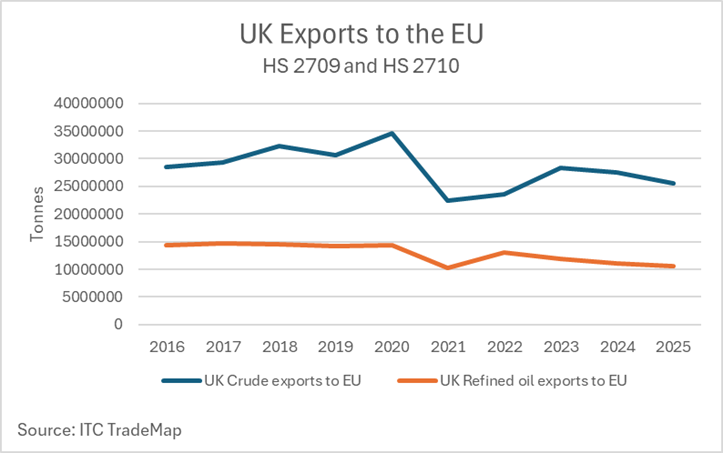
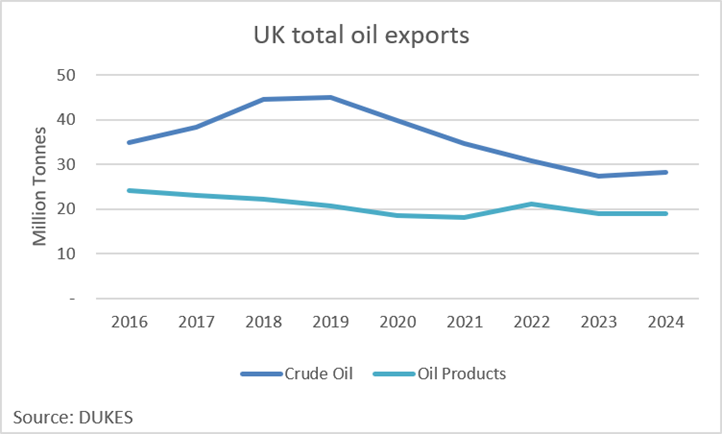
The UK government’s Net Zero policy has had a more detrimental effect on UK exports to the EU than Brexit. Lower UK oil and gas production, due to restrictions on developing new fields and an excessive 78% tax rate on North Sea oil and gas companies, has unsurprisingly reduced UK oil and gas production and, consequently, its fuel exports. Fuel exports used to be among the UK’s largest. Both crude and refined oil exports to the EU, measured in tonnes to remove price fluctuations, declined by 26% between 2020 and 2025. Total UK crude oil exports fell by 37% between 2019 and 2024, according to the most recent DUKES publication. Trying to blame this decline on Brexit is duplicitous. BBC journalists should acknowledge that both current and previous governments’ Net Zero policies are responsible. The BBC is also a cheerleader for Net Zero, so it should be pleased by lower oil exports and should stop pretending this is due to Brexit policies.
Relationship-building won’t increase UK oil and gas production.
3. Net Zero mandates have also reduced chemical and car exports
Lower UK oil production and refining capacity have further reduced UK exports of chemicals and plastics: organic chemical exports to the EU fell by 51% between 2019 and 2025, while plastics exports to the EU declined by 10% over the same period. Chemicals are the UK’s second-largest goods export sector after machinery and transport equipment. This fall in chemical manufacturing has hit total UK exports. This has nothing to do with Brexit, and relationship-building won’t change it.
However, the most significant decline in exports has been in the UK’s exports of internal combustion engine (ICE) cars. Car manufacturing is a major UK export industry and part of the Machinery and Transport equipment sector. About 80% of the cars made in the UK are for export.
The UK and EU originally aimed to stop sales of new Internal Combustion Engine cars by 2035; however, the UK accelerated this to 2030, while the EU maintained the 2035 target, which it recently reduced to 90%. The UK has also announced that it will permit the sale of hybrid cars until 2035, but has retained its 2030 deadline for ICE sales.
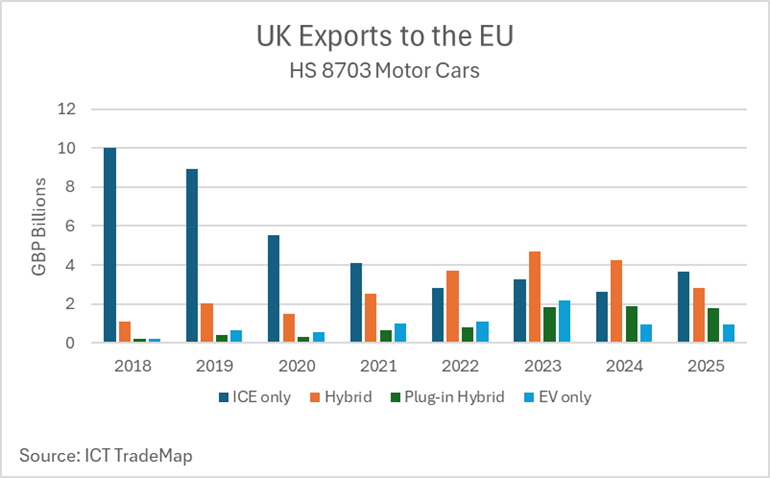
EV mandates have severely affected UK car production in general, as well as exports to the EU. Total UK car exports (HS8703) to the EU were 23% lower in 2025 than in 2019 due to reduced exports of petrol and diesel cars. UK exports of ICE-only petrol cars to the EU decreased by 38% between 2019 and 2025, while exports of ICE-only diesel cars plummeted by 95%, resulting in a combined loss of exports worth £5.3 billion. Although exports of hybrid, plug-in hybrids, and EVs have increased by around 83%, a gain of £2.5 billion, this still leaves UK car exports to the EU £2.8 billion lower than they were in 2019.
This is not a relationship issue; this is a regulation issue. The UK government should not try to blame Brexit for the impact of its ill-advised regulations on vehicle engines on UK exports.
However, salvation is at hand. UK ICE cars are extremely popular in the US, and the US has agreed to reduce its Section 232 tariffs on 100,000 UK cars from 27.5% to 10%. This took effect on 30 June 2025 under Executive Order 14309. However, the US could withdraw this concession if the UK government agrees to align with EU SPS, food and agriculture regulations, as reciprocal beef exports were part of the US-UK trade deal. Why would the government do this? UK vehicle exports are much more important to the UK economy than food exports to the EU.
Relationship-building won’t reverse the EV mandate.
4. Trade has not changed, but how we measure it has
There has been a significant structural change in what can be classified as a UK or EU export under the rules of origin in the UK-EU Trade and Cooperation Agreement (TCA). UK and EU goods exports are only tariff-free and quota-free under the TCA, if they meet the required Regional Value Content (RVC) to qualify as UK or EU products. The TCA’s regional value requirements exclude many products that were previously classified as UK or EU goods by the EU’s statistical agency, Intrastat, because these goods were simply imports distributed from UK or EU ports.
The TCA RVC requires that unprocessed agricultural products be wholly sourced from either the UK or the EU to be traded tariff- and quota-free. This has led to the removal of many goods from the UK’s trade statistics. The most obvious example is tropical fruit and nuts, which once accounted for a significant portion of UK fruit exports to the EU; see the chart below.
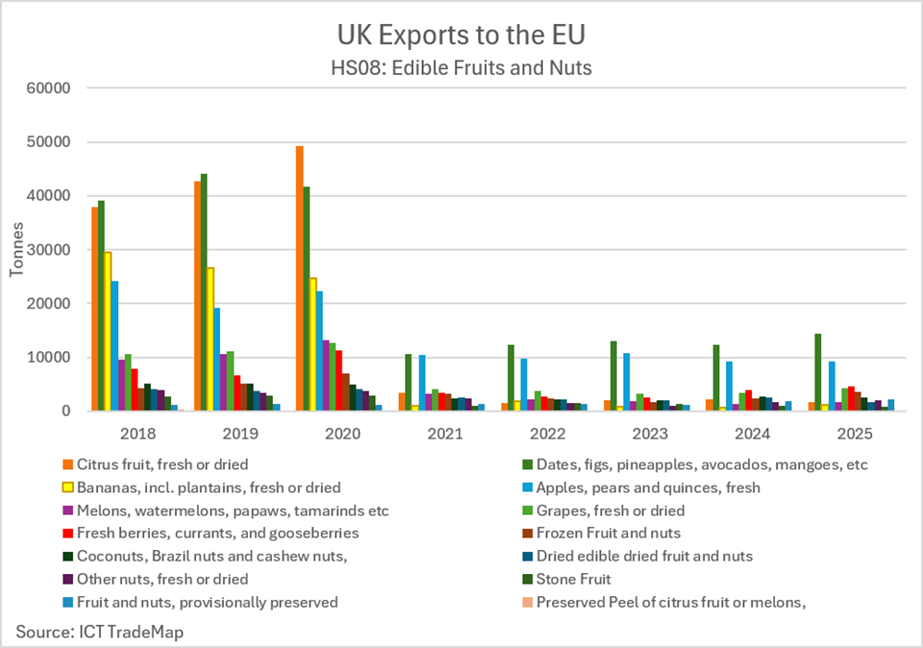
UK Fruit exports to the EU fell from 200,000 tonnes in 2020 to 50,000 in 2025. The largest export reductions were in Citrus fruit, down by 96%, Bananas and Plantains, down by 95%, and melons and pawpaws, down by 88%. In 2020, citrus fruit was the UK’s largest fruit export by volume, even though the UK does not have the climate to grow citrus fruit. These would have been oranges from South Africa and limes from India and the Caribbean, landed and distributed from the UK to other EU destinations. Similarly, the UK cannot grow cashews, coconuts, bananas, avocadoes or mangoes, but the EU’s Intrastat recorded these as UK exports before Brexit. These were never UK products; they were primarily grown in Commonwealth countries and distributed to other EU countries from the UK.
Relationship building, aligning with EU SPS regulations or signing a veterinary agreement will not change a product’s origin nor allow it to meet the RVC required by the TCA. UK fruit exports will never return to their previous levels unless we really do have massive global warming.
Relationship-building won’t turn the UK into a tropical fruit producer.
5. Regional Value Content removed many goods from trade statistics
However, regional value requirements have not only excluded unprocessed agricultural goods from UK export statistics. UK exports of unsorted diamonds (HS 710210) to the EU varied from between £400 million and £1.1 billion pounds before Brexit, but exports are now nearly zero. These diamonds would have been re-exports of uncut diamonds imported from Australia, Canada, and Zimbabwe.
No amount of relationship building with the EU will change this.
The RVC for manufactured goods prevents many UK-branded goods from being counted as UK exports when manufactured in Asia for a UK company. For example, clothing RVC requires that the fabric must be woven or knitted, cut, and sewn in the UK. Hats, shoes, textiles, umbrellas, and walking sticks have similarly restrictive regional content requirements. Furniture, lighting, electrical equipment, optical equipment, toys, games, and sports equipment are limited to 50% of the value of the non-originating material (ex works). However, some miscellaneous manufactured articles may not have more than 15% non-originating value.
UK goods that do not meet the TCA’s regional value requirements were responsible for a £7 billion reduction in UK exports to the EU between 2019 and 2024. No amount of relationship building will turn golf balls and golf clubs, musical instruments, textiles, cutlery, glassware, clothing, or footwear made in Asia for UK companies into UK exports to the EU under the rules of the TCA.
This is also true for imports from the EU: shoes imported from Belgium and the Netherlands appear to have dropped by over £1 billion since 2019, while UK shoe imports from Vietnam have increased by a similar amount. A perfect example of the Rotterdam effect.
Some goods were granted a transition period to comply with the new content requirements. Notably, electric vehicles were mandated to use locally produced batteries by January 2024; this requirement was extended to the end of 2026, when it became clear that neither the UK nor the EU could meet the deadline. However, other products had compliance deadlines in 2023 and 2024 that were not extended, such as active pharmaceutical ingredients, certain petrochemical-based products, and specific biopharmaceuticals, which had to be sourced within the UK or the EU to avoid tariffs.
No amount of relationship-building with the EU will ever allow the UK and EU to pretend that goods made in China, Vietnam, Bangladesh, etc., for UK or EU companies are actually UK or EU exports.
Just because the EU is still kidding itself that goods landed in Rotterdam are actually Dutch exports, the UK can no longer play that game. The BBC should understand the structural differences in UK trade statistics since Brexit.
Relationship-building won’t increase the regional value of UK exports.
6. The choice of base years changes the results
The BBC should be aware that economists who support rejoining the EU avoid comparing exports in 2025 to those in 2017, 2016, or any year preceding the Brexit referendum; they focus solely on 2018 and 2019 because they know there was considerable stockpiling of many goods with long or indefinite shelf lives.
Goods were stockpiled in 2018 and 2019 ahead of Brexit to avoid potential tariffs if the UK and EU could not reach a trade deal, which also exaggerated the decline in UK-EU trade between 2018/19 and 2025.
Reviewing trade between two single years fails to provide insight into UK or EU trade dynamics. Economists who favour remaining in the EU often compare 2018 or 2019 with 2025 to demonstrate a decline in UK trade, while ignoring the fact that UK-EU trade rules remained unchanged until January 1, 2021. No one wishes to use 2020 as a base year because it was the first year of COVID, even though the UK kept its ports open and its trading relationship with the EU unchanged.
My favourite example is HS 89: Ships, boats, and floating structures: the UK typically exports ships worth around £500 million to the EU each year, except in 2019 when this figure doubled to £1.1 billion, largely due to the export of a luxury yacht to Malta. After that, UK exports to the EU returned to approximately £500 million, but the 2019 spike contributes to the misconception that Brexit is responsible for the decline in UK exports. Trade statistics also show stockpiling before Brexit in arms and ammunition, clocks and watches, ceramic products, carpets and floor coverings, pyrotechnic products, jewellery, and various food preparations such as mustard, condiments, and cheese. But has the BBC ever mentioned this?
Relationship-building won’t remove pre-Brexit stockpiling from past trade figures.
7. Relative currencies and carbon taxes affect competitiveness
Relative currency values matter in trade. The UK also has a high relative currency, making UK goods even more expensive and less competitive in the EU. The Bank of England has the power to change this, but improved relationships won’t. The European Central Bank has been cutting its interest rates furiously since September 2023. The ECB’s deposit rate has fallen from 4% in September 2023 to 2% in June 2025, where it has remained, while the Bank of England only reduced its September 2023 rate of 5.25% to 3.75% in 2026. This interest rate differential will help keep the pound relatively higher than the Euro.
The UK has the highest industrial energy costs among developed countries, so it is an expensive producer of homogeneous goods, especially energy-intensive manufactured materials. Joining the EU’s Emissions Trading Scheme (ETS), as proposed in the government’s Reset, will increase the carbon taxes paid by UK manufacturers. At present, the EU ETS is about 20% higher than the UK’s ETS, and the UK will retain its Carbon Price Support tax until 2028, as well as its Climate Change Levy on UK industry. Together, these 3 carbon taxes will wipe out what is left of UK industry.
Relationship-building won’t lower the pound or reduce UK carbon taxes.
8. EU agriculture is still subsidised; a veterinary agreement won’t increase UK competitiveness
The suggestion that a veterinary agreement with the EU, including alignment on agricultural standards, would reduce post-Brexit red tape for food, farm, and fish exports overlooks some very basic economic factors that are the real causes of the decline in UK agricultural exports to the EU. There is a large difference in competitiveness between UK and EU food, which is primarily due to EU agricultural subsidies and the currency differential, not red tape.
The EU still subsidises its farmers through the Common Agricultural Policy (CAP), with payments ranging from €100 to €250 per hectare, along with additional payments for smaller farms, those with natural constraints such as poor or steep land, and for environmental or rural development programs. These payments, combined with a weaker currency, make EU food cheaper in the UK than UK products, as the UK has phased out its Basic Payment Scheme for Farmers and replaced it with environmental subsidies for taking land out of production. This lowers domestic production and increases domestic prices.
The UK is not self-sufficient in food and imported 35% of the food it consumed in 2025. How would it benefit the UK to tie itself to EU standards? The UK already has a significant agri-food trade deficit with the EU. No amount of relationship-building will make UK agrifoods more competitive in the EU, and the current proposal to dynamically align with the EU’s Sanitary and Phytosanitary regulations will only bind the UK to sourcing imported food from EU producers rather than more efficient non-EU suppliers.
No amount of ‘relationship building’ will subsidise UK farmers.
9. Trade is determined by the economic health of your trading partners
The economic health of your trading partners also matters. The large EU economies have had even lower growth than the UK since 2019. Annual GDP growth in 2025: France was only 0.8%, Italy was 0.7%, and Germany was 0.2%. The Netherlands has recovered, with GDP up 1.3%, and Belgium’s 2025 GDP is expected to be 1%. Together with Ireland, these countries are the UK’s largest EU trading partners, accounting for almost two-thirds of UK exports to the EU. The BBC should not be surprised if these countries aren’t spending lavishly on expensive UK exports. No amount of ‘relationship building’ will change this, nor will aligning with EU regulations, nor giving France even more of the UK’s fishing grounds.
10. UK industry is dying due to excessive energy costs, regulations, and taxes – goods exports will die with it
The BBC should recognise that several UK industries are in terminal decline, adversely affecting their exports. Examples include UK steel, aluminium, and zinc products. If the UK can no longer produce goods due to uncompetitive production costs, carbon taxes, and corporate taxes, UK companies will relocate their production to more favourable locations. These locations are seldom within the EU, where energy costs, carbon taxes, packaging taxes, and other corporate taxes tend to be as high or higher than in the UK, except for Irish corporate taxes.
This is also true of the many UK chemical exports to the EU, which have been falling steadily since 2013, after the introduction of the Carbon Price Support tax, environmental regulations, emissions trading schemes, a lack of investment in new production facilities, and a shortage of raw materials from the UK’s few remaining oil refineries. Better relations with the EU won’t change this. In fact, most of the UK’s chemical, steel, and aluminium woes stem from regulations and carbon taxes that were in place when we were part of the EU.
Some goods exports have been affected by both the RVC rules and the UK’s environmental regulations. For example, the UK’s exports of semi-finished products of iron or non-alloy steel containing less than 0.25% carbon have dropped by 91%. This decline is partially due to the TCA’s rules of origin, which halved exports of these products, and then, in 2024, exports collapsed after the closure of the UK’s Port Talbot steel mill in September 2024.
No amount of ‘relationship building’ will rejuvenate the UK’s lost industries.
Conclusion
Trade is much more about supply, demand and overall competitiveness than the BBC understands or is willing to admit. Trade is determined by the relative efficiency of production, relative currency values, and the economic health of both your trading partners and your domestic industries. UK-EU trade statistics have the added complication of changing both the definition of what can be counted as a UK or EU export. The accuracy of UK trade data has improved after the data-gathering body moved from the EU’s Intrastat surveys to HMRC’s more exact data collection for tariff imposition. The latter has a much greater financial incentive to be accurate. The former has a political incentive to make EU trade between member states appear higher than it is.
No amount of ‘relationship building’, ‘regulatory alignment’, veterinary agreements, or capitulation to aggressive EU demands for youth mobility schemes, discounted student fees, and greater access to UK fishing grounds will increase UK goods exports to the EU.
The only way to increase UK exports is to create a better economic environment for producing internationally competitive goods in the UK.
The government could start by removing its carbon taxes, emission regulations, renewable energy subsidies, EV mandates, punitive taxes on oil and gas companies, and legal restrictions on new oil and gas field development. Wasting time haggling with the economically moribund EU about lifting its overbearing SPS rules will not increase UK exports.
This article is based on one that I wrote for the book Brexit: The Facts Strike Back. Please buy two, and send one to your favourite BBC Remainer.
I bought some celery the other week origin Spain. Marked “Not for EU sale”. Has Spain left the EU?
Yesterday I bought some British grown celery, no label restricting where it could be sold.
It rather makes the point about the so-called trade statistics.
Thanks Catherine. An Excellent exposition of the economic truth about Brexit. To misquote the film : A Few Good Men, the remainiacs and climate zealots at the BBC can;t handle the truth. Your explanation of the reality is available to anyone who consults official statistics with an open mind.