
Trump’s new trade rules.
Why the EU's Trade Bazooka would backfire

A year ago, Donald Trump was inaugurated as the 47th President of the United States and immediately warned the world that he would change the way the US conducts trade by applying tariffs by country rather than by product type.
This was a clever move. When David Ricardo proposed his theory of comparative advantage and trade in 1817, he used England and Portugal as examples of trading partners. Portugal is England’s oldest ally: the first Anglo-Portuguese Treaty was signed in 1373, and both countries still have a formal alliance. Ricardo did not use trade between England and France as an example, as England had only just won the Battle of Waterloo against the French. The unmentioned inference of Ricardo’s theory is that free trade works amongst allies with something to sell (port and cloth in Ricardo’s case). Donald Trump had also come to this conclusion.
The Most Favoured Nation principle is out of date
The core principle of the international trade regulations, known as the General Agreement on Tariffs and Trade (GATT), is that its members must apply the same tariff on the same type of good if it is imported from any other GATT member.
However, almost since the GATT’s inception, countries have been using non-tariff barriers to restrict competitively priced imports and/or openly subsidising their domestic producers so that their goods are more competitive in both domestic and international markets. (The GATT was absorbed by the WTO in 1995 and is now administered by them.)
For a long time, the US turned a blind eye to non-tariff trade barriers, as they helped countries devastated by the Second World War rebuild their economies. Non-Tariff barriers and restrictions on currency transfers also helped many impoverished Asian nations build their manufacturing capacity in the 1970s and 1980s. The well-meaning American, Cordell Hull, the main architect of postwar trade liberalisation, possibly assumed that once countries had rebuilt their cities and industries, they would lower their trade barriers. How wrong he was, especially about the EU.
The EU began as the European Coal and Steel Community in 1952, expanded its remit to all economic sectors in 1958 to become the European Economic Community, in 1962 it began subsidising its agricultural production, and in 1968 it formed a Customs Union. The Customs Union abolished all internal tariffs between its members but applied high tariffs and regulatory restrictions on all goods imported from outside the Union.
Modern Tariffs are extremely granular; they can change at the ten-digit level of Harmonised System tariff codes based on packaging size or the sweetness of the goods. But not by whether they were made by friend or foe, or in countries where energy is subsidised, or where ports, storage areas and roads connecting them are built by the government, or in factories on land given to the enterprise, even goods made by slave labour will be charged the same tariff if the country exporting them is a member of the WTO.
This equal treatment for all members was understandable when the US established the GATT in 1947, as only 23 countries were signatories. And they all generally had similar ways of doing business. Many were Commonwealth countries: Australia, Burma (Myanmar), Canada, Ceylon (Sri Lanka), India, New Zealand, Pakistan, Zimbabwe, South Africa and the United Kingdom. The only European nations to join, other than the UK, were the Benelux countries (Belgium, the Netherlands, and Luxembourg), Norway, France and Czechoslovakia (now the Czech Republic and Slovakia). Brazil, Chile, and Cuba also joined. As did Syria and Lebanon.
The World Trade Organisation (WTO) absorbed the GATT in 1995 and now has 164 members, including several with very different attitudes to trade, economic governance, human rights, workers’ rights, government subsidies, etc., but their export goods all face the same tariff rate from other WTO members. This is known as the Most Favoured Nation rule.
All countries have a consolidated tariff schedule, sometimes called a Schedule of Concessions, which sets the maximum tariff rate legally allowed for imports from other WTO members. Countries can charge less than their published maximum tariff, but under the WTO rules, all WTO members should also be charged less.
Trump’s new trade rules
A year ago, Trump threw this process up in the air and demanded that countries that were excluding US goods from their own markets with non-tariff barriers and other restrictions, as well as countries dominating the US domestic market with subsidised products, would face higher US tariffs than countries that do not resort to these practices. And that all imported goods would be subject to a minimum 10% tariff. This is effectively a VAT on imported goods, which makes more sense than applying VAT to all goods, as most EU countries do.
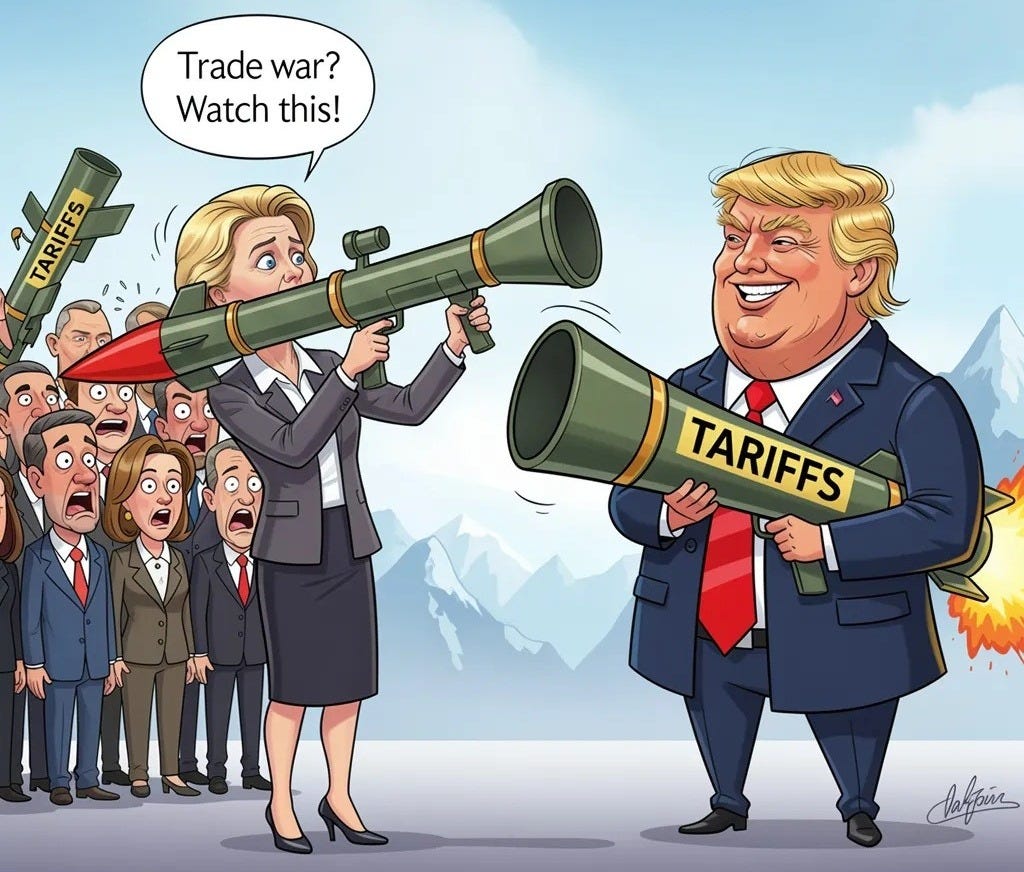
Trump knew he was on strong ground with his new trade rules due to the might of the US consumer market. The US is the single largest consumer market, accounting for 15%-18% of global consumption, ahead of China, the EU, and India. All countries that severely restrict imports with high tariffs and non-tariff barriers. Because of this lack of consumer competition, US consumer demand heavily influences global supply chains, commodity markets and multinational corporate strategies. Changes in US interest rates, inflation rates, or fiscal policy will affect the bottom lines of companies worldwide. Unlike the EU, Trump really does have a trade Bazooka.
Even if the Supreme Court decides that the US IEEPA tariffs applied to individual countries are against US laws, Trump and his Trade Representative can still increase tariffs using Sections 232 (national Security), Section 301 (Unfair foreign trade practices), Section 201 (safeguards for US industries), and Section 336 (adjust tariffs to equalise costs of production).
Trump could also take a leaf out of the EU’s book and start using non-tariff barriers, such as requiring imports to comply with US energy regulations, banning the use of US product names, some examples could be blue jeans, hamburgers (yes they’re American, the German version didn’t have a bun) and trainers, and imposing tiny quotas on more efficient producers to prevent imports from countries he doesn’t like. Maybe he could force all imported goods to use US labelling and US agricultural processes, or he could let each US state interpret the trade laws differently – the EU currently does all of these things.
Who really has a Trade Bazooka
Last week, Trump distracted the EU leadership by reiterating his 2019 desire to buy Greenland and threatening to impose 10% tariffs on all goods from eight European countries ( Denmark, France, Germany, the UK, Sweden, Norway, Finland and the Netherlands) from February 2026 unless a deal for the complete and total purchase of Greenland was reached. He also warned that these tariffs would increase to 25% by June 2026 if his demand were not met.
The EU officials considered retaliating by applying what they termed a “Trade Bazooka” on US goods. This would include retaliatory tariffs, restrictions on US market access in key sectors, and the suspension of the ratification of the EU-US trade deal agreed last year.
There are several problems with this strategy:
1. The US economy is not as dependent on trade, especially trade with the EU. However, the EU is. The World Bank calculates that US Trade is equal to 25% of its GDP, while for the EU, trade is equal to 92% of its GDP.
2. Only 18% of US imports come from the EU. They were worth $618 Billion in 2024. The US is the EU’s largest market. The EU cannot afford a trade war with the US.
3. The EU’s largest export sector to the US is pharmaceutical products, and these are mainly exported from Ireland by US companies based there for tax reasons. Trump already wants these companies to reshore their manufacturing to the US. A trade war would only make this easier.
4. The second and third largest EU exports to the US are turbojets, turbopropellers and other gas turbines and Vehicles. All things the US excels at making, and where the US manufacturers would appreciate less EU competition. When Trump was told about the EU’s Trade Bazooka, I imagine him repeating Clint Eastwood’s famous line from Dirty Harry: ‘Go ahead, make my Day.’
5. Almost everything the EU exports to the US competes with US-manufactured goods. The EU has few unique resources or products that the US couldn’t produce domestically or source more cheaply from other suppliers.
6. On the other hand, US exports to the EU in 2024 were only $371 billion, and a fifth of this was fuel – LNG and oil. The EU has almost no oil and gas resources and must import them. And the US is the world’s largest exporter of hydrocarbon-based fuels.
The EU is snookered.
The EU has always restricted US finished goods imports through non-tariff barriers, so it doesn’t have a big stick or bazooka to threaten the US. The EU tries to throw its weight around by insisting that its trading partners follow EU rules, but then only wants to export EU goods, not import goods from those partners. The tiny quotas in its latest Mercosur trade agreement are a perfect example. The EU primarily imports the raw materials it needs to make higher-value goods. So, raw materials unavailable in the EU are imported tariff-free; refined materials have higher tariffs; finished goods have the highest tariffs; and goods from countries with which the EU has trade agreements are excluded due to non-compliance with EU regulations or limited by tiny quotas.
The EU saw itself as a ‘Regulatory Superpower’ imposing and enforcing the world’s trade regulations. The EU is incensed that Trump is now setting global trade rules that vary by country rather than by product. Under Trump’s new rules, US allies who pay for their own defence will get better treatment than those that don’t buy US goods but expect the US to defend them in a war, i.e., the EU.
In the end, Trump didn’t implement the additional 10% tariffs, as he seems to have got the total access to Greenland he wanted. However, by referring to their retaliation proposal as a ‘Bazooka’, EU officials probably only reminded the US president that EU countries aren’t spending enough on their own defence and still rely on the US for military protection. If they try this again, perhaps they should use a less suggestive name.
You're knocking it out of the park with these fact-based articles, Catherine. Among all the mainstream media lies and manipulation, you're not so much a breath of fresh air, but more of a bracing gale-force wind. Great stuff.
There's a new UK YouTube show called Rich Does Politics. He's a lovely guy and, even though his channel is still quite new and small, he has one of the best regular guest lists (independent media, anti-Globalist types) I think I've ever seen.
I think Rich might welcome a trade expert with the knack of explaining complex markets jargon in layman's terms. I'll email him now with my Catherine McBride - OBE, trade, commodities, agriculture, financial services, expert pitch.