

EU regulatory dump will not boost UK growth
The Bank of England Governor ought to understand this.

Not so long ago, the head of the Financial Conduct Authority (FCA) said of EU financial service regulations: “We are having lawyers go through page by page to say which elements will be inoperable if you just dumped them into UK legislation because they relate to different institutions and organisational structures.”1
That FCA CEO was Andrew Bailey, now the Governor of the Bank of England, so I was surprised to read that he is supporting the Starmer Government’s plan to dump hundreds of EU food and agricultural regulations on UK food manufacturers, food scientists and British farmers without a regulation-by-regulation review.
Bailey appears to be under the misapprehension that this regulation dump will ‘rebuild trade relations with Europe’ and ‘boost growth’. Presumably, the Governor also supports the UK joining the EU’s more expensive ETS market, which will increase carbon taxes on the UK’s few remaining manufacturers. Neither EU capitulation will ‘boost UK growth’. Instead, UK taxpayers will be forced to pay the EU to watch the UK economy sink under the weight of EU regulations.
The EU’s food and agricultural regulations.
Not only will the Reset force the UK to reinstate the farming, crop science and food production rules that were changed when we left the EU, we will also have to add thousands of new EU regulations. While we were free from the EU’s control, the EU imposed 13,000 Regulations and 12,000 Directives on its members, many of which cover food and agriculture. The EU’s changes range from banning food ingredients to lowering maximum pesticide residue limits to stricter packaging waste rules.
All UK food producers and manufacturers will have to comply with all EU food and farming regulations under Starmer’s reset, even if they do not export any food or agricultural products to the EU. And let’s be honest – that means most of them. The UK produced only 65% of the food it consumed in 2024; the 2025 figures have yet to be released, but countries that rely heavily on imported food rarely have much surplus food to export.
Who’s reviewing EU regulations?
Bailey’s statement last week displays a level of arrogance prevalent in Westminster and the City of London: in 2017 the FCA recognised that not all EU financial services regulations were appropriate for the UK and employed 15 lawyers full-time to work through the EU rulebook. But when the regulation dump falls on another more vital industry, food production, Bailey happily supports a blanket dump of EU food and agricultural regulations onto UK food producers. Increasing regulatory costs on companies will not ‘boost growth’ – the Bank of England Governor ought to know this.
And it is not just Bailey; Nick Thomas Symonds’ staff have yet to publish a granular analysis of the costs and consequences for UK food production of blindly following all EU regulations now and in the future. Instead, with zero knowledge of the EU rulebook or UK trade figures, Thomas Symonds agreed in May last year to join the EU’s SPS area, adopt its lower animal welfare standards and its unscientific ‘precautionary’ food standards. Thomas Symonds didn’t even bother to review what those EU regulations entailed or how much they had changed since we left the EU. Even during the last year, the EU has continued to add to its regulatory burden. A burden that will now also fall on all UK farmers, food producers and food technicians.
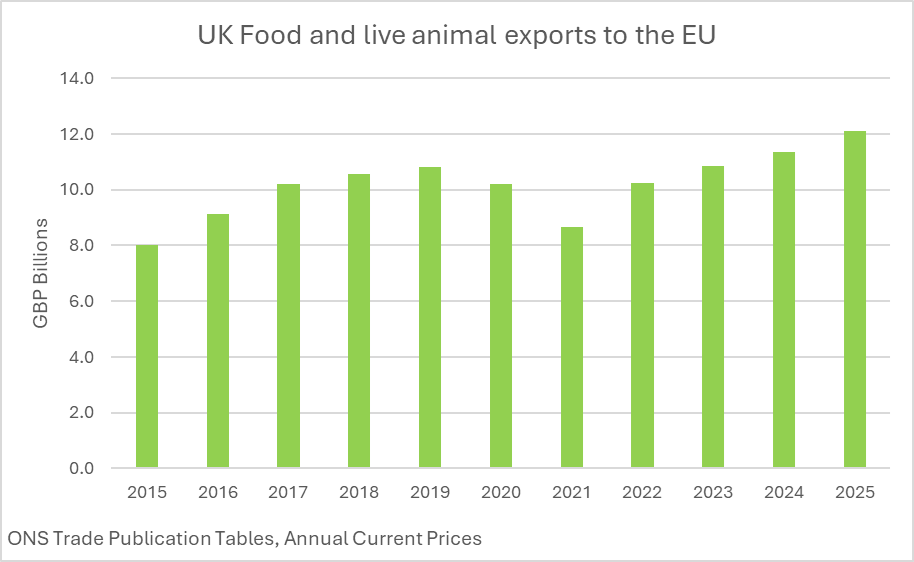
Thomas Symonds claimed that UK agrifood exporters had spent £210 million since 2023 on something he called ‘paperwork taxes’. This works out at just £70 million a year. Since 2023, the UK has exported food and live animals worth £34.309 BILLION to the EU2 £210 million is just 0.6% of this amount. All UK food producers are about to be hit with a mountain of regulation so that a handful of UK exporters to the EU can reduce some of their export costs. Ironically, if they are manufacturing this food in the UK, they are likely to find that their energy costs rise by far more than this ‘saving’ when the UK joins the EU ETS and has to pay higher carbon taxes.
I should also point out that this is not a ‘paperwork tax’; it is the cost of exporting goods to the EU, just as UK exporters exporting goods to the US have to pay for their US compliance costs. And, I should add, just as exporters from all over the world have to pay for UK compliance costs when they export goods to the UK. Unfortunately, some clever lobbyists have conned UK politicians yet again into using taxpayers’ money to pay their clients’ private export costs.
Trading with the EU is not free, even for EU members
What hasn’t been explained very clearly by the government, nor mentioned by the Bank of England Governor, is that the UK taxpayer will have to pay for this capitulation to EU rules. According to The Express and The Independent, the cost will be ‘around’ £1 billion a year. The UK exported only £12.1 billion of food and live animals to the EU in 2025, but Thomas Symonds has agreed to pay the EU £1 billion of taxpayers’ money so that a handful of private company exporters can save themselves £70 million. I have trouble believing that even Thomas Symond is this stupid.
For balance, The Grocer claims that UK payments for the SPS portion of the Reset would be just £700 million annually, and my own calculations made last November based on Norway’s payments came to a similar figure. But even £700 million is 10x the annual SPS cost to exporters that Thomas Symond claims he is trying to alleviate. Instead, UK taxpayers will primarily subsidise the EU with this money, while reducing the costs for a handful of private export companies, some of which are EU companies. The UK’s top ten food exporters to the EU include two Danish companies, Arla and Tulip, a German company, Muller, and an Irish company, Kingate Investments, as well as two US multinationals. It is also worth noting that export health certificates and veterinary checks for food exports to the EU are issued by UK local authorities. So most of the £70 million that Thomas Symonds is so concerned about does not go to the EU but to UK local authorities; the loss of this revenue stream for local authorities should be subtracted from any ‘saving’.
Why not just subsidise the Health Checks?
If the government were seriously concerned about the EU’s SPS compliance costs for UK food exporters, it could have subsidised the health checks rather than agreeing to pay the EU to join its SPS area and force non-exporting companies to change their production methods to comply with EU regulations. This would have saved UK taxpayers 90% of the proposed SPS payment and saved non-exporting UK farmers and food manufacturers untold amounts in compliance costs. We can only imagine why the Government didn’t think of this.
Not that SPS health certificates are the only cost of exporting food to the EU: UK exporters will still have to complete: customs declarations; rules of origin compliance to qualify for zero tariffs under the Trade and Cooperation Agreement; VAT obligations and potentially register for EU VAT and file EU VAT returns on B2C sales; comply with EU safety, labelling, and packaging rules including EU waste rules; EU EORI forms; EU Safety and Security declarations, packing lists and transport documents; and submit to EU customs risk checks, anti-fraud checks, security screening and weight/volume inspections as well as pay the usual haulage costs, insurance and cold chain energy costs. All those other costs will still exist, even under the proposed EU SPS capitulation.
And yet, some commentators continue to claim merely removing SPS export health certificates and veterinary checks will boost the UK economy by £5 billion ‘a year’. That is absurd. The original claim was £9 billion ‘by 2040’, i.e. about £600 million a year. In total, the UK only exported £12 billion of food and live animals to the EU in 2025. Removing a tiny amount of paperwork while leaving all other costs in place won’t increase UK food exports by £5 billion, a 40% increase in total food exports. The UK doesn’t have the capacity to increase its production by this amount and didn’t export anywhere near that amount of food when it was a full EU member (see the graph above). According to the ONS, UK food and live animal exports in 2020, the last year of the UK EU Transition Agreement, were only £10.8 billion in current prices, despite full EU access, and only £12.9 billion in CVM-adjusted prices.
One of the few UK animal products with net exports to the EU is milk, but UK farmers already export almost all, 97% to be exact, of those exports to Ireland, without any red tape restrictions, presumably because the milk comes from Northern Ireland, which already follows EU SPS regulations but has never had to pay the EU to do this. According to DEFRA’s Agriculture in the UK data sets, Table 8.6, the UK produced 15.128 billion litres of milk in 2024, the largest volume since 1986 – despite ‘Brexit’ red tape allegedly preventing agrifood exports, which is not evident in any of Defra’s data tables. It is hard to imagine how UK farmers could suddenly increase their milk production by another 40%.
The UK has never exported very much food to the EU because UK food is comparatively more expensive than EU food. Many EU food exporting countries have more farmland compared to the size of their populations, so have excess food to export, such as Ireland, or they have mechanised their production and rely on supplying the larger UK market, such as the Netherlands and Denmark, or they have warmer weather, longer growing seasons and can grow fruit and vegetables that the UK can’t, such as Spain. Add to this the fact that EU farmers are still subsidised through the CAP payments system and that those subsidies were increased in the budget after the UK left the EU and will be increased again in the next budget. Then consider that EU industrial electricity costs are lower than those in the UK, so food processing costs are generally lower in the EU. It should be obvious to Andrew Bailey why UK food exports to the EU are less than 30% of UK imports from the EU and why paying to join the EU’s SPS area will not change this.
Low UK food exports have nothing to do with red tape but everything to do with the UK not subsidising farmland, increasing the minimum wage for young workers, increasing employers’ national insurance, and the UK having the highest industrial energy prices in the developed world. The Government could fix all of these issues if it wanted to boost UK growth without paying to comply with EU regulations. Instead, it seems hell-bent on subjugating the country to the EU and is happy to ignore the economic consequences. It is incredible that the Governor of the Bank of England isn’t warning them against this course of action.
Instead, the Bank of England Governor and the Starmer Cabinet seem to be the only people in the UK who didn’t understand the message in the Reform Party’s resounding victory in Thursday’s election. Reform was not elected by a population desperate to let the EU make UK regulations. Reform was not elected by a population that wants to send billions of pounds to the EU, thereby increasing government borrowing. Reform was not elected so that all UK companies will have to spend money complying with EU regulations, even if they don’t trade with the EU.
p.s. Bailey is correct; Adam Smith did believe that trade promoted economic growth, but in Smith’s lifetime, Britain’s largest trading partners were its American colonies and the West Indies.
‘FCA chief warns Brexit will require page-by-page review of EU rules’, 2 February 2017, Peter Spence, The Daily Telegraph
ONS, UK trade in goods and services annual at current market prices: 2023, £10.860; 2024, £11,340; 2025, £12,109. I have not used CVM numbers because the £210 million cost is also in current prices.
Thank you for another very informative article. It's become obvious that the Labour government took office chanting economic growth with not the faintest idea as to how it might be brought about. This latest thrashing about over the EU is entirely consistent: an economy that has the government's knee planted firmly on its neck is unlikely to thrive. One hallmark of socialism is a governing class that thinks it knows better than ordinary mortals, and believes there's always someone else to bear the cost.
The Blair and Brown governments were said to have had a bad case of legislative diarrhoea, oblivious to the impossibility of reading, understanding and acting on their output. The EU has it. I'm reminded of Groucho Marx: "From the moment I picked up your book to the moment I put it down I never stopped laughing. Someday I intend reading it."